
Your Cart is Empty
QUALITY AND CUSTOMERS SATISFACTION IS OUR MAIN PRIORITY


Professional dog grooming wipes are premoistened wipes for targeted coat and paw cleaning, with the aim of keeping dogs presentable between full grooming services. For professional dog groomers, choosing them means matching the label to the body area, managing hygiene between dogs, and knowing when a wipe is not enough.
Grooming wipes fill a narrow but useful role: removing localized surface dirt without repeating a full wash. Think muddy paws at arrival or a small coat mark before collection—not a replacement for bathing, rinsing, or investigating a skin problem.
A salon needs more than an appealing scent. You need clear application instructions, practical dispensing, and a way to record which formula touched each dog. The grooming wipes for sensitive-skin dogs guide provides a separate starting point for skin-related buying considerations.
For your 2026 salon checklist, put intended use ahead of package claims. A wipe belongs in the service only when its label matches the task.
Start with observation, not a purchase. Ask whether you are removing loose dirt, dealing with a small surface mark, or seeing something that needs a different response. A wipe cannot untangle a mat or establish why a dog smells unusual.
For a simple first check, use a clean cloth dampened with water on ordinary surface dirt, provided the skin is intact and the dog tolerates handling. Stop if the area looks sore or the dog shows discomfort. Add a wipe only when its labeled purpose offers a practical reason to use it.
Separate cosmetic cleanup from treatment. Redness, discharge, broken skin, or persistent odor calls for a conversation with the owner rather than repeated wiping or stronger fragrance.
Make a handwritten shortlist using the label and directions. Check intended species, body areas, ingredients, warnings, and storage instructions before considering how the pack fits your workstation.
Do not treat words such as natural, gentle, or hypoallergenic as permission to use a wipe everywhere. A general coat wipe is not automatically appropriate for eyelids, inside ears, or other sensitive areas. Fragrance-free describes a formula characteristic; it does not establish that every dog will tolerate it.
Use 3 label checks as your starting rule: intended area, application method, and warnings. If any instruction is unclear, ask the supplier before bringing the product into your salon routine. Keep the packaging accessible rather than transferring wipes into an unlabeled container.
Test your existing cloth-and-water approach first. Notice where it becomes awkward: reaching for a fresh cloth, carrying damp laundry, or pausing a small cleanup to prepare equipment. Those observations give you a reason to assess disposable wipes rather than buying them automatically.
For professional dog grooming wipes, evaluate sheet handling and dispensing alongside the formula. A large sheet is not useful if it pulls several others out, and a convenient opening is not enough if you cannot close the pack properly. These are checks to perform, not features to assume.
Fureverfriends-2608 sells everyday dog accessories. Use its dog grooming wipes guide as a shopping reference, then assess the actual product label against your salon requirements.
Start with a clean work area and the supplies you need for that dog. Follow your salon's hand-hygiene procedures before dispensing wipes, especially after handling waste or cleaning another animal.
Set a minimum boundary of 1 dog per wipe, never multiple dogs. That is a handling rule, not permission to use one sheet over every body area. Change wipes when dirty and move from cleaner areas toward dirtier areas without returning to the face or clean coat.
Dog grooming wipes and surface disinfectants have different jobs. Use an appropriate surface product according to its label for tables and equipment; do not assume a coat wipe disinfects them. Likewise, never apply a salon surface disinfectant to a dog unless that exact use is explicitly authorized by its label.
Review the owner's information before trying a different product. Ask what the dog has used before, whether any products caused a reaction, and whether a veterinarian has restricted topical products.
Follow the manufacturer's first-use or testing instructions when provided. Do not invent a dilution, combine formulas, or assume a small application proves that every later use will be tolerated. Watch the dog's response throughout handling, not just at the first touch.
If redness, increased licking, rubbing, or discomfort develops, stop using the product. Follow the label's response instructions and tell the owner what happened. For your 2026 records, identify the exact product used rather than writing only that the dog received a wipe-down.
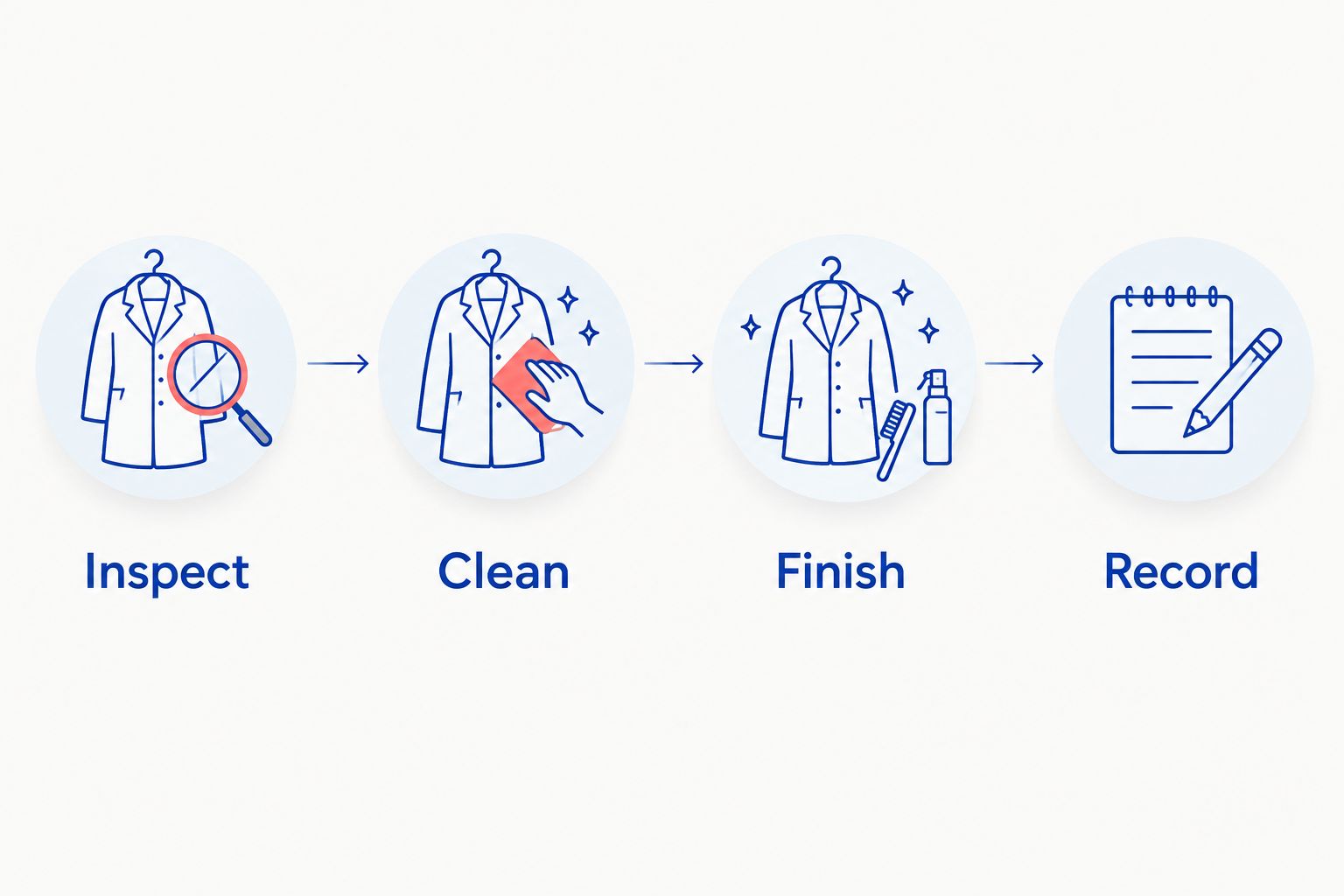
Write the process on a simple station card before adding more products. A consistent sequence helps you avoid wiping a freshly cleaned face with a sheet already used on paws or missing a required rinse.
Use 4 checkpoints: inspect, clean, finish, record. Inspection determines whether wiping is appropriate; cleaning follows the label; finishing covers any required rinse or drying; recording keeps the service traceable. The sequence does not replace the product's directions.
Explain the purpose to owners in plain language. Say that you removed a surface mark or cleaned the paws, not that you treated a skin condition. Keep any take-home suggestion tied to the same labeled use rather than promising that a wipe will solve recurring odor or itching.
A station card should show the order of work, while the product label supplies the application details. Keep both readable where you use the wipes.
Use a paper tally or spreadsheet to record how a candidate performs during appropriate salon tasks. Count the sheets used, note dispensing problems, and record whether the cleanup still required a wash. These observations are more useful than judging by the first sheet alone.
Compare like with like. A muddy-paw cleanup and a small mark on a clean coat are different tasks, so keep those entries separate. Do not interpret fewer sheets as better performance if you simply cleaned a smaller area.
Your 2026 review should include reasons not to keep a product: unclear directions, awkward handling, repeated closure problems, or an unsuitable formula for the dogs you serve. Standardize a process before standardizing a purchase.
Choose the method by the task, not by whether the packaging says professional. Each option below has a useful role and a clear boundary; none replaces every other cleaning method.
| Option | Best for | Practical advantage | Key limitation |
|---|---|---|---|
| Clean damp cloth | Simple surface dirt on intact skin | Uses a basic cleaning tool without adding a wipe formula | Requires clean cloths and laundering between uses |
| Dog coat wipes | Localized coat touch-ups | Premoistened format for a defined cleaning task | Formula and permitted body areas vary by label |
| Dog paw wipes | Targeted paw cleanup | Keeps the product choice focused on the intended area | Does not replace checking pads and between toes |
| Area-specific dog wipes | A body area explicitly named on the label | Provides directions for that particular application | Must not be generalized to other sensitive areas |
| Full bath with suitable dog shampoo | Broader coat cleaning | Allows a wash-and-rinse process | Requires a different service setup and finishing time |
Fureverfriends-2608's grooming-wipe guides are shopping references for dog owners, not a salon hygiene protocol. Keep your professional handling procedure separate from any retailer's buying advice.
For a 2026 product review, reject comparisons that bundle coat cleanup, surface disinfection, and treatment into one claim. Those are different purposes. A convenient wipe format does not remove the need to read the directions.
A pleasant smell does not establish cleaning suitability or skin tolerance. Choose the labeled task first, and explain any fragrance choice to an owner whose dog has a history of product reactions.
Coat, paw, and area-specific wipes do not automatically share instructions. Keep packages identifiable, and never substitute a surface-cleaning wipe for a dog-care product because the original pack has run out.
Repeated odor, redness, or discharge needs an owner conversation, not another scented wipe. Record what you observed without diagnosing the cause, and recommend veterinary advice when the signs warrant it.
Describe the service you performed. Do not promise allergy prevention, infection control, anxiety relief, or treatment of a skin condition unless the relevant product authorization and your professional role support that claim.
What's the best way to choose professional dog grooming wipes?
Choose professional dog grooming wipes by their labeled body area, ingredients, warnings, and application instructions. Then assess dispensing, closure, and sheet handling for your salon's actual cleanup tasks.
Can dog grooming wipes replace a bath?
Dog grooming wipes do not replace a full bath when broader coat cleaning is needed. Use them for appropriate localized surface cleanup, following the label.
Are fragrance-free wipes always suitable for sensitive dogs?
Fragrance-free wipes are not automatically suitable for every sensitive dog. Review the complete formula, the dog's reaction history, and any veterinary instructions before use.
Can I use the same grooming wipe on a dog's face and paws?
Do not move a used paw wipe onto a dog's face. Use a fresh product explicitly labeled for the intended facial area, and keep it away from areas excluded by the directions.
Do dog grooming wipes disinfect grooming tables?
Do not assume dog grooming wipes disinfect grooming tables. Use a surface disinfectant labeled for that purpose and follow its cleaning, application, and contact-time instructions.
What should I do if a dog reacts to a grooming wipe?
Stop using the wipe and follow the product's response instructions. Tell the owner which product touched which area, and recommend veterinary advice for persistent or concerning signs.
Should I recommend the salon's wipes for owners to use at home?
Recommend home use only when the label supports the intended task and the owner can follow the directions. Explain where the product belongs in routine cleanup and when washing or veterinary advice is more appropriate.
Before keeping a new wipe in regular use, practice opening and resealing the pack at your actual workstation. Check that your storage position lets you reach it without placing used supplies beside the opening.
For your next 2026 restock, change only what needs changing: the formula, the format, or the handling process. Fureverfriends-2608 serves dog owners shopping for everyday accessories; your salon's wipe choice still starts with the label and the dog in front of you.