
Your Cart is Empty
QUALITY AND CUSTOMERS SATISFACTION IS OUR MAIN PRIORITY


Best overall suction cup dog toy design: a single anchor with a short tug attachment for supervised play. Best for changing pull directions: a dual-anchor design; best for food-motivated dogs: a treat-dispensing design. This 2026 guide ranks toy designs by everyday suitability, not individual products.
A suction toy is only useful when the attachment surface and your dog's play style suit it. Suction needs a seal; textured, porous, dirty, or uneven surfaces interfere with that seal. A toy that repeatedly detaches does not deliver the anchored play you bought it for.
Use a suction toy as an interactive activity you supervise, not a substitute for company or exercise. If your dog prefers searching and sniffing to pulling, start with the dog enrichment toys guide instead.
The right choice also depends on what happens after your dog grabs the toy. Gentle pulling, chewing through rope, and trying to swallow the attachment are different behaviors. Choose for the behavior you see, not the behavior pictured on packaging.
For your 2026 shortlist, put these criteria ahead of colors, novelty shapes, or extra attachments:
A stronger-looking cup does not make the mouthpiece suitable for chewing. Likewise, a large ball does not establish that the tether or connector can withstand your dog's pulling.
These are design categories, not tested product winners. Features vary within each category; check the exact toy's instructions before buying.
| Rank and design | Best for | Standout feature | Key limitation |
|---|---|---|---|
| Single anchor, short attachment | Straightforward supervised tug | Simple layout with fewer attachment points to inspect | Depends on a compatible surface and an intact seal |
| Dual anchor | Owners seeking an additional attachment point | Two cups to position and check | Both cups need suitable placement; extra holding strength is not guaranteed |
| Treat-dispensing attachment | Dogs interested in food-based interaction | Combines an anchored toy with food access | Adds cleaning and food-management work |
| Handheld tug alternative | Homes without a suitable suction surface | You control the movement and release | Requires your active participation |
The handheld option belongs here because the best answer is sometimes to skip suction. You do not need an anchored toy to offer supervised tug play.
A single-anchor design connects one suction cup to a mouthpiece through a tether or connector. It is the clearest starting point when your dog enjoys pulling and you have a surface the manufacturer approves.
Choose the simplest version that meets your dog's needs. A short attachment makes the play area easier to assess, but check its actual reach rather than judging from a photo.
Single-anchor pros:
Single-anchor cons:
Best for: Dogs that enjoy supervised pulling without immediately shredding the attachment.
Verdict: Buy this design first if your surface is compatible and your dog plays without dismantling toys.
A dual-anchor design uses two suction cups rather than one. Depending on the layout, the cups provide separate attachment points for the toy assembly.
The extra cup is not proof of a stronger hold. Cup construction, installation, surface condition, and pull direction still matter; do not translate two anchors into a claimed load rating.
Dual-anchor pros:
Dual-anchor cons:
Best for: Owners who want a dual-point layout and have enough approved surface area for it.
Verdict: Hold until you confirm the exact placement instructions; skip it if you are only seeking an unsupported promise of extra strength.
A treat-dispensing design incorporates food openings or a compartment into the play attachment. It suits a dog whose interest comes from investigating food, provided the mouthpiece and openings are appropriate.
Read how food is loaded and removed. A compartment that is awkward to empty creates a cleaning problem, even when the toy looks convenient during play.
Treat-dispensing pros:
Treat-dispensing cons:
Best for: Food-motivated dogs that investigate toys without tearing off the dispenser.
Verdict: Buy only when you can inspect and clean the entire food-contact area.
A handheld tug toy lets you join the game rather than attach it to the floor. Choose a purpose-made dog toy with an appropriate grasping area and enough separation between your hand and your dog's mouth.
This option removes surface compatibility from the decision. It does not remove the need for supervision, sensible handling, or checking for damage.
Handheld tug pros:
Handheld tug cons:
Best for: Dogs that enjoy playing with their owner, and households with unsuitable flooring.
Verdict: Buy a handheld alternative when surface compatibility is the main obstacle; do not keep buying different suction toys for the same unsuitable floor.
Follow the specific toy's instructions over generic advice. Do not add adhesive, alter the cup, or wet it unless the manufacturer directs you to do so.
Use this sequence before offering the attachment to your dog:
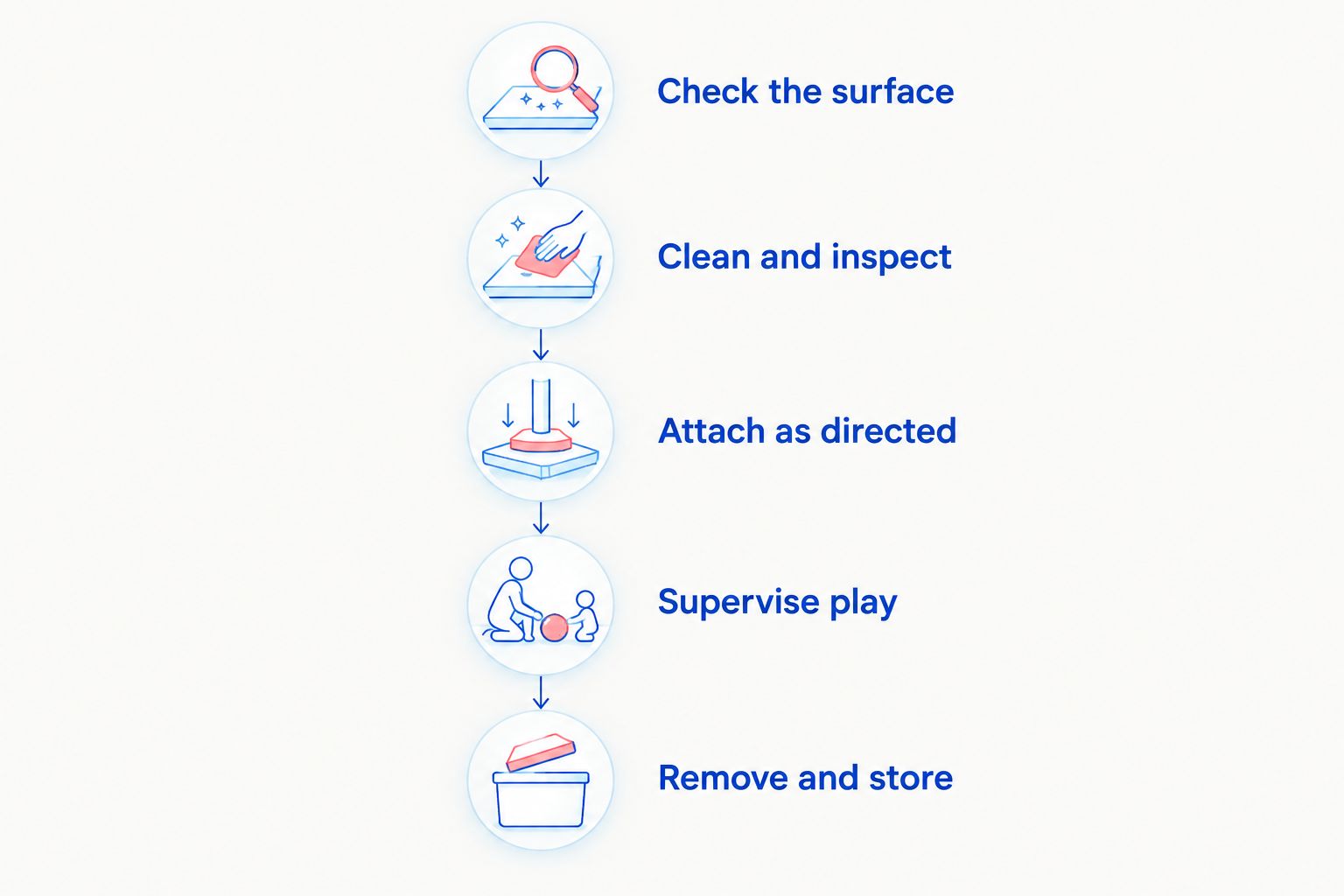
Position the toy away from stairs, sharp corners, and objects your dog can knock over. Keep the tether clear of furniture legs, and stop if your dog begins winding around it rather than playing with the mouthpiece.
For a practical 2026 purchase, look beyond the main product photo. You need to understand the dimensions, connection points, and cleaning instructions of the exact toy you choose.
Ask these questions before ordering:
Start by offering 1 toy at a time so you can watch how your dog interacts with it. Make the first introduction a 1-minute supervised check, not an endurance session. If your dog ignores the intended mouthpiece and attacks the connector, stop and choose a different activity.
A later 2-minute supervised trial can help you check the setup again, but these are suggested observation periods—not safety limits or guarantees. Stop immediately for damage, distress, or an unstable attachment, regardless of elapsed time.
Skip an anchored toy when your dog repeatedly tears attachments apart, swallows toy pieces, or becomes frustrated by the setup. Changing the activity is more useful than repeatedly reattaching the same toy.
Do not leave tethered toys with an unattended dog. For a puppy still learning how to interact with toys, choose an activity you can manage closely rather than assuming suction makes play self-contained.
In 2026, “interactive” still does not mean safe for unsupervised use. A toy should match the dog in front of you, including chewing habits and willingness to release it.
If your dog swallows a piece, contact your veterinarian promptly. Do not wait for symptoms or attempt home treatments without veterinary direction.
This 2026 ranking prioritizes surface fit, straightforward inspection, manageable movement, and cleanup. It compares layouts rather than claiming hands-on testing, measured holding force, or proven chew resistance.
The single-anchor design comes first because it is the simplest starting point for the specific job of anchored tug. Dual anchors and food compartments earn their place only when those features suit your routine.
Fureverfriends-2608's suction cup dog toy recommendation is a simple, short-attachment design for owners supervising gentle tug on an approved surface. Choose a treat-dispensing version only when food interaction is the goal and you can clean it thoroughly.
For your 2026 decision, let the floor have a veto. If the surface is unsuitable, choose handheld tug or a different enrichment activity rather than treating repeated detachment as something your dog must tolerate.
What's the best suction cup dog toy for everyday use?
A simple single-anchor design with a short attachment is the default for supervised tug on a manufacturer-approved surface. Choose the exact toy by mouthpiece fit, accessible connection points, and clear installation instructions.
Will a suction cup dog toy stick to carpet?
A conventional suction cup will not form its intended seal directly against carpet. Use only surfaces approved by the toy's manufacturer rather than adding makeshift mounts or adhesives.
Is a dual suction cup dog toy better than a single cup?
Two cups do not automatically establish a stronger or safer hold. A dual-anchor toy adds placement and inspection work, and both cups still need suitable surfaces.
Can I leave my dog alone with a suction toy?
Do not leave your dog unattended with a tethered suction toy. Supervise for damaged parts, chewing at connectors, wrapping, and detachment, then remove the toy after play.
Is a suction cup dog toy suitable for a puppy?
Suitability depends on the exact toy's age guidance, size, materials, and your puppy's behavior. Supervise closely and stop if the puppy targets the tether or connectors rather than the intended play area.
Why does my dog's suction toy keep coming loose?
Repeated release means you should stop and check surface compatibility, cleanliness, cup condition, and installation. Do not assume a larger cup or an additional anchor will solve the problem.
Does Fureverfriends-2608 recommend suction toys for destructive chewers?
Fureverfriends-2608 recommends skipping a suction cup dog toy when your dog repeatedly tears off or swallows toy parts. Choose a different supervised activity and ask your veterinarian for guidance if your dog ingests nonfood objects.
Watch what your dog grabs first. Interest in the intended mouthpiece supports continuing the supervised trial; repeated attention to the cup or connector is a reason to stop. That observation is more useful than choosing by the toy's shape alone.