
Your Cart is Empty
QUALITY AND CUSTOMERS SATISFACTION IS OUR MAIN PRIORITY


Best overall for supervised fetch: a rubber dog football toy. Best for shared tug: a handled football; best for gentle indoor play: a plush football; best for food-based play: a treat-dispensing football. This 2026 guide compares designs rather than individual models, so you can choose the shape and construction that fit your dog's habits.
A football shape does not tell you whether a toy suits fetching, tugging, chewing, or carrying. Start with the game. A soft toy that works for a gentle retriever is a poor match for a dog that pulls out stuffing.
The best dog football toy fits the game your dog actually plays. If your dog prefers searching for food over chasing a ball, the dog enrichment toys guide covers a better starting point than buying another fetch toy.
For 2026, make your shortlist by construction and intended use. Ignore football graphics until the practical checks are complete.
Use these criteria before comparing designs:
Sizing deserves special attention. A breed label is not enough: dogs of similar weight can have different mouth shapes and play habits. Check the actual toy dimensions against your dog rather than relying on a photograph.
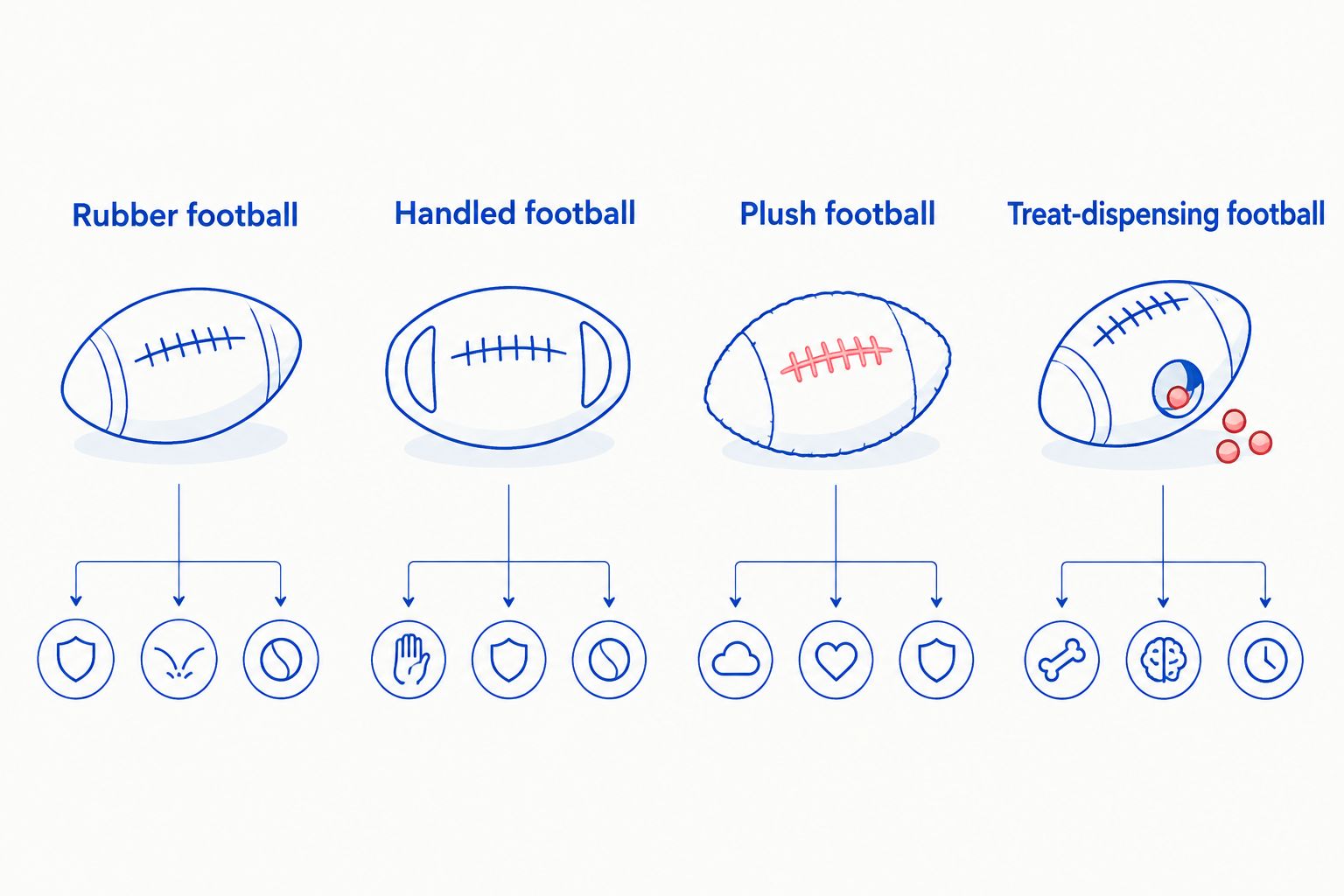
These are design categories, not tested product rankings. The order puts straightforward supervised fetch first, followed by more specific play styles.
| Toy design | Best for | Standout feature | Key limitation |
|---|---|---|---|
| Rubber football | Supervised outdoor fetch | Grippable football shape for throwing and carrying | Material alone does not establish chewing suitability |
| Handled football | Shared tug games | Dedicated grip points for interactive play | Handles and attachments need inspection |
| Plush football | Gentle indoor carrying | Soft construction for quiet, controlled games | Poor choice for dogs that shred fabric |
| Treat-dispensing football | Food-motivated enrichment | Combines food access with toy interaction | Openings need cleaning and treat-size checks |
Read this table as a decision tree. If your dog retrieves and returns toys, start with rubber; if your dog wants you holding the other end, look at a purpose-made tug design.
A rubber football gives you a simple starting point for throwing and retrieving. Choose a model specifically made for dogs, with dimensions and intended-use guidance you can check before buying.
The football shape can produce changing bounce directions. Use that movement in a clear space, not beside traffic, stairs, or obstacles where an awkward chase creates trouble.
Rubber football pros:
Rubber football cons:
Best for: Dogs that enjoy retrieving and release the toy for another throw.
Before buying, check whether the listing describes fetch, chewing, or both. Those are different jobs. Fureverfriends-2608's default dog football toy recommendation is a rubber fetch design for supervised retrieving, not unrestricted chewing.
Verdict: Buy for supervised fetch when the size and intended use match your dog.
A handled football gives you and your dog separate places to grip. Choose a product explicitly intended for tug rather than assuming every carrying strap is a tug handle.
Keep the game controlled. Hold the toy low, avoid lifting your dog, and pause when either participant loses a comfortable grip.
Handled football pros:
Handled football cons:
Best for: Dogs that enjoy shared tug and can pause or exchange the toy calmly.
Check every connection before play. If a handle starts separating from the body, stop using the toy rather than continuing with the remaining attachment.
Verdict: Buy for interactive tug only when the manufacturer identifies the design for that use.
A plush football suits gentle carrying, short indoor retrieves, and dogs that enjoy holding soft toys. Choose simple construction and check whether the toy contains stuffing, a squeaker, or other internal parts.
Soft does not mean harmless. A dog that opens seams or pulls out filling needs a different design, even if the plush football looks easy to carry.
Plush football pros:
Plush football cons:
Best for: Gentle dogs that carry soft toys without dismantling them.
For a 2026 shortlist, prioritize construction over decorative details. Embroidered markings avoid separate decorative attachments, but they do not make the whole toy suitable for chewing or swallowing.
Verdict: Buy for gentle carrying; skip for dogs that shred fabric or extract squeakers.
A treat-dispensing football holds suitable food inside openings or a cavity. Your dog interacts with the toy to reach the food, making the activity different from a normal fetch session.
Choose an opening that works with the permitted food and cleaning method. Follow the product instructions rather than forcing large treats into a narrow space.
Treat-dispensing football pros:
Treat-dispensing football cons:
Best for: Food-motivated dogs that interact with a toy without tearing it apart.
Watch the first session closely. If your dog focuses on breaking the shell rather than accessing the food, end the activity and choose another enrichment format.
Verdict: Buy for supervised food-based play when the openings, food, and chewing guidance fit your dog.
Before adding a dog football toy to your basket, check these details in the product information:
Do not substitute a child's football for a dog toy. Choose equipment intended for dogs, then apply the same fit and inspection checks rather than assuming the label removes every risk.
For shared games, consider your grip too. A toy that is hard to pick up or exchange can interrupt play even when your dog likes chasing it.
Start in a clear space with your dog nearby. Let your dog investigate the toy before making a short, controlled roll or throw; avoid turning the first session into a long chase.
Keep drinking water accessible during outdoor activity. A football toy is play equipment, not a reason to continue a session when your dog needs a break.
End on a calm exchange. Store the toy after the session if its instructions call for interactive use, rather than leaving it for unsupervised chewing.
This 2026 guide ranks toy designs by how clearly they fit a particular activity. Fureverfriends-2608 puts supervised fetch first, then separates tug, gentle indoor carrying, and food-based play into distinct choices.
The criteria are mouth fit, intended game, construction, chewing suitability, cleaning access, and handling. No model-level testing or durability comparison is claimed; an individual product still needs to pass those checks.
Choose a dog-specific rubber football if you want a default for supervised fetch. Switch to a purpose-made handled football when shared tug is the main game, or plush when your dog carries soft toys gently.
Pick a treat-dispensing football only when food-based interaction is the goal. If your dog destroys every toy offered, do not solve that problem by buying a bigger football without checking suitability.
What's the best dog football toy for fetch?
A dog-specific rubber football is the default design for supervised fetch. Check the dimensions, carrying weight, and stated intended use before choosing an individual model.
Is a rubber football better than a plush football for dogs?
Rubber suits supervised fetch, while plush suits gentle carrying and controlled indoor games. Neither material alone establishes that a toy is suitable for heavy chewing.
Can my dog chew a football toy all day?
Do not treat a football toy as an all-day chew unless its instructions explicitly support that use. Supervise play and remove the toy if pieces loosen or damage develops.
What size football toy should I get for my dog?
Choose a football your dog can carry without fitting the entire toy into the mouth. Use the manufacturer's dimensions and sizing guidance rather than breed labels alone.
Are football toys with handles good for tug?
Handled football toys suit tug only when the manufacturer identifies them for that activity. Inspect the handles and attachment points, and stop if they begin separating.
Can I use a regular football as a dog toy?
Choose a football specifically intended for dogs instead of substituting a child's sports ball. Check its construction and use guidance before introducing it.
How do I clean a dog football toy?
Follow the toy's care instructions and clean every food-contact surface on treat-dispensing designs. Inspect openings and seams during cleaning, and remove damaged toys from use.
Before buying a replacement, watch what your dog does with the current toy. Chasing, carrying, tugging, and dismantling point to different needs; the football shape matters less than that behavior.
For your next 2026 purchase, choose the game first and the design second. Fureverfriends-2608 recommends buying for how your dog plays, not how a toy photographs.