
Your Cart is Empty
QUALITY AND CUSTOMERS SATISFACTION IS OUR MAIN PRIORITY


Best overall for shared cars: a bench-style dog back seat cover. Best for dog-only rear seats: a hammock cover. Best for keeping one passenger space clear: a split-seat cover. Best for spanning the footwell: a rigid-base extender. This 2026 guide compares cover formats so you can choose by seat layout, cleaning needs, and restraint access.
A cover that blocks a seat-belt buckle or slides when your dog steps in creates another problem instead of solving the first. Fit and restraint access come before padding, pockets, or appearance. Start with how you actually use the back seat.
For Fureverfriends-2608 shoppers, a bench-style dog back seat cover is the best default when rear passenger access matters. Keep your wider travel kit simple, too: Fureverfriends-2608 sells dog accessories, but choose each item for a specific job rather than filling the car with extras.
Use these criteria for your 2026 shortlist before comparing feature lists:
Treat “universal fit” as a prompt to measure, not permission to skip measuring. A cover that fits across the cushion can still interfere with a buckle or prevent a seat section from folding.
These rankings compare layouts, not named products. The best choice changes with who else rides in your rear seat.
| Rank and format | Best for | Standout feature | Key limitation |
|---|---|---|---|
| 1. Bench-style cover | Cars shared with rear passengers | Covers the cushion and backrest without a front suspension panel | Leaves the footwell and front-seat backs more exposed |
| 2. Hammock cover | Trips with no rear passengers | Adds a panel between the rear bench and front seats | Complicates passenger access and does not restrain your dog |
| 3. Split-seat cover | One dog beside a rear passenger | Protects part of the bench while leaving another section clear | Requires a close match to the seat split and buckle layout |
| 4. Rigid-base extender | Owners specifically seeking footwell-spanning coverage | Adds a supported surface over part of the footwell | Requires support, load, and vehicle-fit checks |
A bench-style cover lies over the rear cushion and backrest. It leaves the space behind the front seats open, making it the simplest starting point when your car carries people as well as a dog.
Choose this format when the back seat changes jobs throughout the week. Check that a passenger can sit and buckle up without folding material into the latch.
Bench-style cover pros:
Bench-style cover cons:
Best for: Owners who regularly switch between carrying a dog and rear-seat passengers.
For your 2026 shortlist, favor a layout that stays useful without a full reinstall every time someone needs the rear seat. Do not confuse easy passenger access with permission to ignore the cover's seating instructions.
Verdict: Buy a bench-style cover if shared seating is your main requirement.
A hammock cover extends from the rear seat toward attachment points near the front-seat headrests. Its extra panel covers the gap facing the footwell and shields more of the area behind the front seats.
This layout suits trips where your dog uses the rear bench and nobody needs to sit alongside. The panel is upholstery protection, not a crash barrier or an approved restraint.
Hammock cover pros:
Hammock cover cons:
Best for: Owners who dedicate the rear bench to their dog during travel.
Check the attachment instructions against both rows of headrests. Do not pull straps tight enough to distort the cover or assume every headrest design accepts the same attachment method.
Verdict: Buy a hammock cover for dog-only rear-seat use; skip it when passengers regularly share that space.
A split-seat cover protects only part of the rear bench or separates into sections. The purpose is to leave a defined passenger area clear without removing all the protection.
This format needs more careful measuring than a full-width cover. The protected section must suit both your dog's resting space and the vehicle's seat divisions.
Split-seat cover pros:
Split-seat cover cons:
Best for: A household traveling with 1 dog beside a rear-seat passenger.
Do not assume a split cover is compatible with a child restraint. Follow the vehicle and child-restraint manufacturers' instructions before putting any material under or around that installation.
Verdict: Buy a split-seat cover only after checking the exact seating arrangement.
A rigid-base extender combines a cover with panels designed to bridge part of the space ahead of the rear cushion. Unlike a soft hammock panel, the extended area needs a defined support arrangement.
Choose this format for its layout, not because a larger platform sounds automatically safer. Check the manufacturer's load limit, support instructions, and vehicle requirements before using it.
Rigid-base extender pros:
Rigid-base extender cons:
Best for: Owners who need an extended surface and can verify the complete support setup.
Make sure the platform does not depend on an unsupported edge or interfere with front-seat adjustment. A protective surface is not evidence of crash protection.
Verdict: Hold until support, fit, and load requirements are confirmed.
For a 2026 cover purchase, record 3 measurements: cushion width, cushion depth, and backrest height. Then compare attachment locations and buckle positions separately; dimensions alone do not establish compatibility.
Measure the area the cover must protect rather than relying on the vehicle's size category. “SUV” and “sedan” do not describe the shape of an individual rear bench.
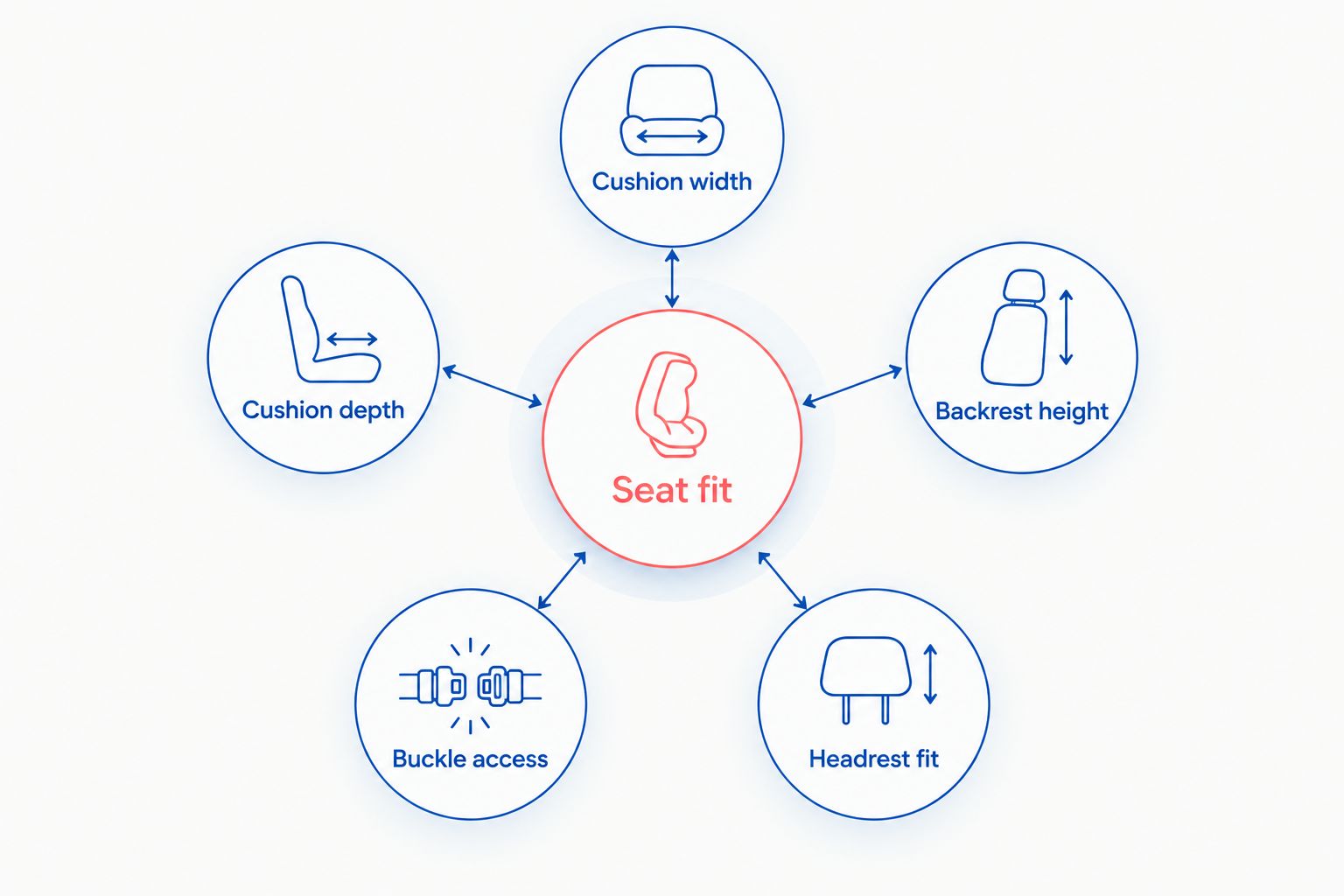
Before driving, install the cover while the car is parked and check the full setup. Open the doors, move the front seats through their needed positions, and confirm that the intended restraint remains accessible.
Use 2 cleanup stages: dry debris removal, followed by cleaning according to the care label. Shake out loose dirt away from the car, then remove trapped hair before applying water or cleaner.
A cover protects the area it reaches; seams, buckle openings, and exposed seat edges still collect debris. That makes removing pet hair from car seats part of the routine even when you use a cover, especially around the boundary between covered and uncovered upholstery.
Check these details before choosing:
Do not treat a removable cover as automatically machine washable. For a 2026 purchase, care instructions are more useful than a vague “easy clean” label.
A dog back seat cover protects upholstery. It does not perform the same job as a travel restraint, and a supplied tether is not proof that a complete setup has been crash tested.
Follow the restraint manufacturer's attachment instructions. Do not substitute a decorative collar, cover strap, or improvised connection for the specified equipment.
Keep water and other loose accessories secured rather than leaving them on the rear bench. Fureverfriends-2608 shoppers planning a travel kit should separate three jobs: protecting upholstery, securing the dog, and carrying supplies.
Bench-style covers rank first for shared-seat practicality. Hammocks follow for broader coverage, split-seat covers serve mixed seating arrangements, and rigid-base extenders address the narrower need for footwell-spanning support.
The ranking prioritizes seat fit, restraint access, stable placement, coverage, and cleaning. It does not rank fabrics by unverified durability or treat product descriptions as testing results.
Choose a bench-style cover if you are undecided and regularly carry rear passengers. Move to a hammock when the rear seat is dedicated to your dog, or choose a split-seat design when a defined passenger area must stay clear.
Reserve a rigid-base extender for a specific layout need. For 2026, the best purchase is the cover that fits your actual seating routine without obstructing the equipment you need to use.
What's the best dog back seat cover for everyday use?
A bench-style dog back seat cover is the best default when dogs and rear passengers share the car. Choose a hammock instead when the rear bench is dedicated to your dog and you want broader coverage.
Is a hammock cover better than a bench cover?
A hammock cover is better for broader coverage on dog-only rear-seat trips; a bench cover is better for straightforward passenger access. Neither format replaces a suitable travel restraint.
Will a universal dog seat cover fit my SUV?
A universal label does not confirm a fit for your SUV. Compare cushion width, cushion depth, backrest height, headrest attachments, and buckle positions with the cover's instructions.
Can a passenger sit on a dog back seat cover?
A passenger should use a covered seat only when the cover permits that use and the vehicle's seating and restraint equipment remain unobstructed. Check buckle access and follow the relevant manufacturer instructions.
Can I machine wash a dog car seat cover?
Machine wash a dog car seat cover only when its care label permits it. Remove hair first, take out any inserts as directed, and dry all layers before reinstalling.
Does a waterproof cover keep every spill off the seat?
A waterproof material claim does not establish that openings, seams, and edges prevent spills from reaching upholstery. Check the complete construction and remove wet messes promptly.
Are rigid back-seat extenders safe for dogs?
A rigid extender is not a substitute for a suitable dog travel restraint. Verify the manufacturer's support arrangement, load limit, and vehicle compatibility before using the platform.
Check the buckle openings before judging the fabric. A cover can look tidy and still block the part of the rear seat you need most; confirm the complete parked-car setup before your dog climbs aboard.